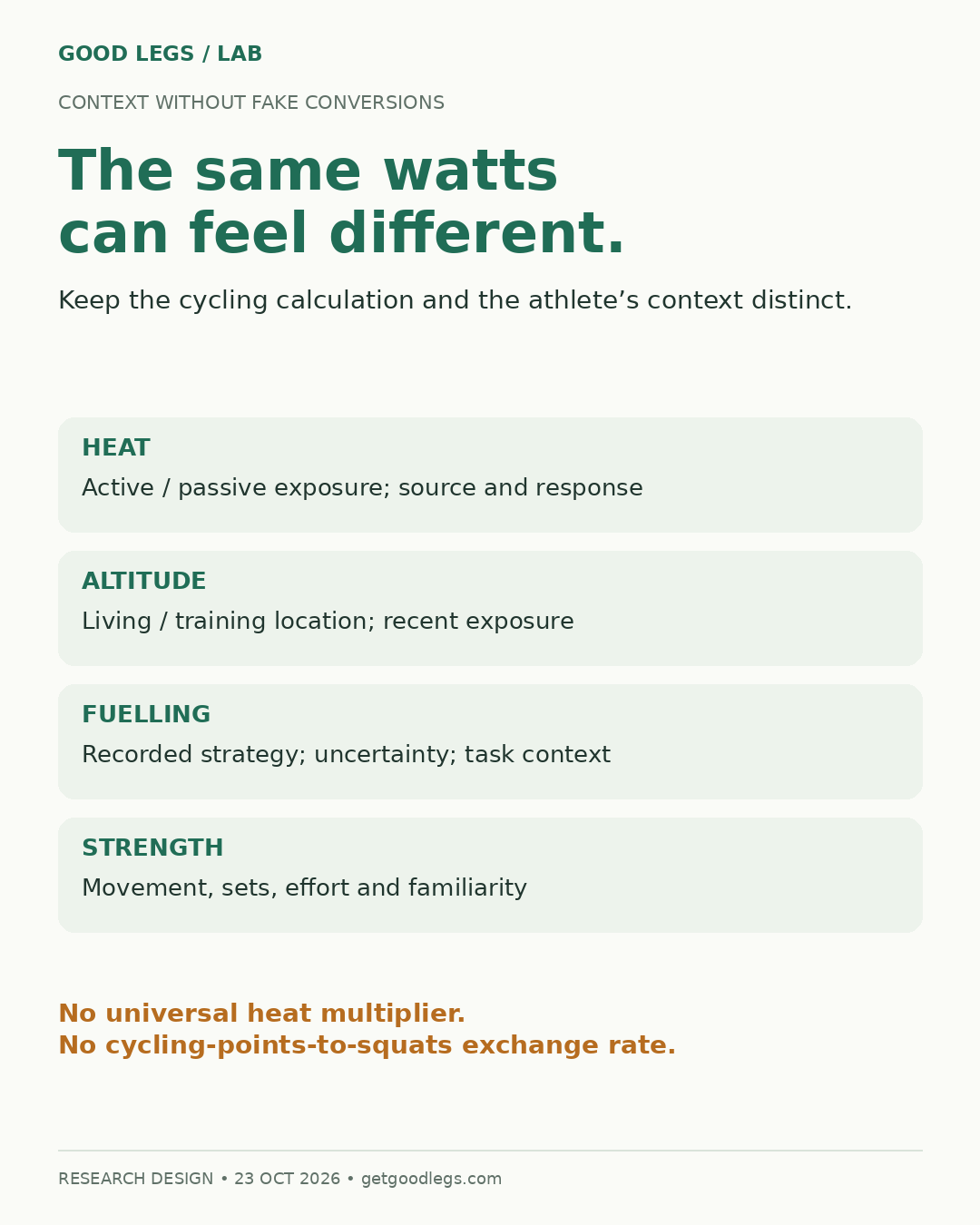
A warm room, a new altitude or an unusual fuelling day can change the experience without changing the work recorded by the power meter.
That creates a useful distinction. External cycling work can stay the same while the athlete’s internal response changes, so a useful training record needs to preserve both pieces of information.
Why not add a heat multiplier?
A universal multiplier would be convenient, although it would imply that we know a single exchange rate between environmental exposure and the stress of cycling.
That is stronger than the evidence available for the proposed GL system. The relevant response can depend on the task, the conditions, recent exposure and the individual. Heat and humidity do not necessarily affect every performance measure in the same way. [D08]
The research design therefore keeps the base cycling calculation stable and records environmental context separately. Active exercise in heat and passive exposure after exercise are different records. A weather estimate and a measured condition also need separate labels, because neither gives us a direct measurement of the athlete’s core temperature during that ride.
Altitude needs two questions
Comparing today’s work with the athlete’s history and assessing power for the current location and task are different questions, which may need different references.
Silently lowering the historical reference at altitude could make the score jump even while absolute power falls. Silently keeping sea-level targets could also be inappropriate. The app needs a declared accounting reference and, when evidence supports it, a separate local task estimate.
Living exposure, training location, travel and acclimation history also belong in the context. None should be collapsed into a precise correction without validation.
Fuelling adds another testable connection
A recent controlled cycling study found that carbohydrate intake changed the decline in an estimate of critical power after prolonged exercise. That finding supports investigating fuelling context; it does not establish a universal intake target or a next-day recovery score. [D02]
The useful question is whether a small amount of reliable context improves a named forecast or decision enough to justify the effort of recording it. When extra questions create an elaborate form without improving decisions, that is a reason to simplify.
This is also why double counting matters. Lowering a local reference, adding a heat penalty and then adding another penalty for a higher heart rate could represent the same effect several times.
The intended explanation is simple: the ride's external dose was this; the conditions and your response were these; here is why the next session is being reviewed. That is clearer than making one number absorb every uncertainty.
Research status: no universal GL heat, altitude or fuelling multiplier has been validated. This article is not an exposure or nutrition prescription.
TEMPORARY ILLUSTRATION · SYNTHETIC DATA
Inspect the supplied illustration
This is a research placeholder while the final graphics are designed. Scroll inside the frame to read the original at full size, or open the image separately.
Sources and their limits.
- Norte et al. (2026). Graded Carbohydrate Ingestion up to 120 g/h Attenuates the Reduction in Critical Power Following 3 h of Moderate-Intensity Exercise in a Dose-Dependent Manner. A controlled study of 16 completers after prolonged exercise, rather than a universal intake target or a next-day recovery forecast.
- Kuo et al. (2026). Impact of Heat and Humidity on Critical Power and Physiological Responses during the Three-Minute All-Out Test in Cyclists. A small acute study of 12 male cyclists, rather than a universal environmental correction factor.