We look at the number after a ride and compare the week with last week, until that comparison begins to shape tomorrow’s training.
That is why choosing the score at the centre of Good Legs deserves more care than choosing a dashboard colour. If the number is going to influence progression, tapers and strength training, we need to know what it measures, what it misses and whether the decisions it supports are better.
Our starting point is straightforward: cyclists need a practical way to count training. Minutes alone do not distinguish an easy spin from hard intervals, so a number that incorporates intensity can make plans and weekly totals easier to understand.
But counting training and predicting its effect are different jobs. A session score can be calculated perfectly and still tell us too little about how an athlete will perform tomorrow.
A useful number, with a precise meaning
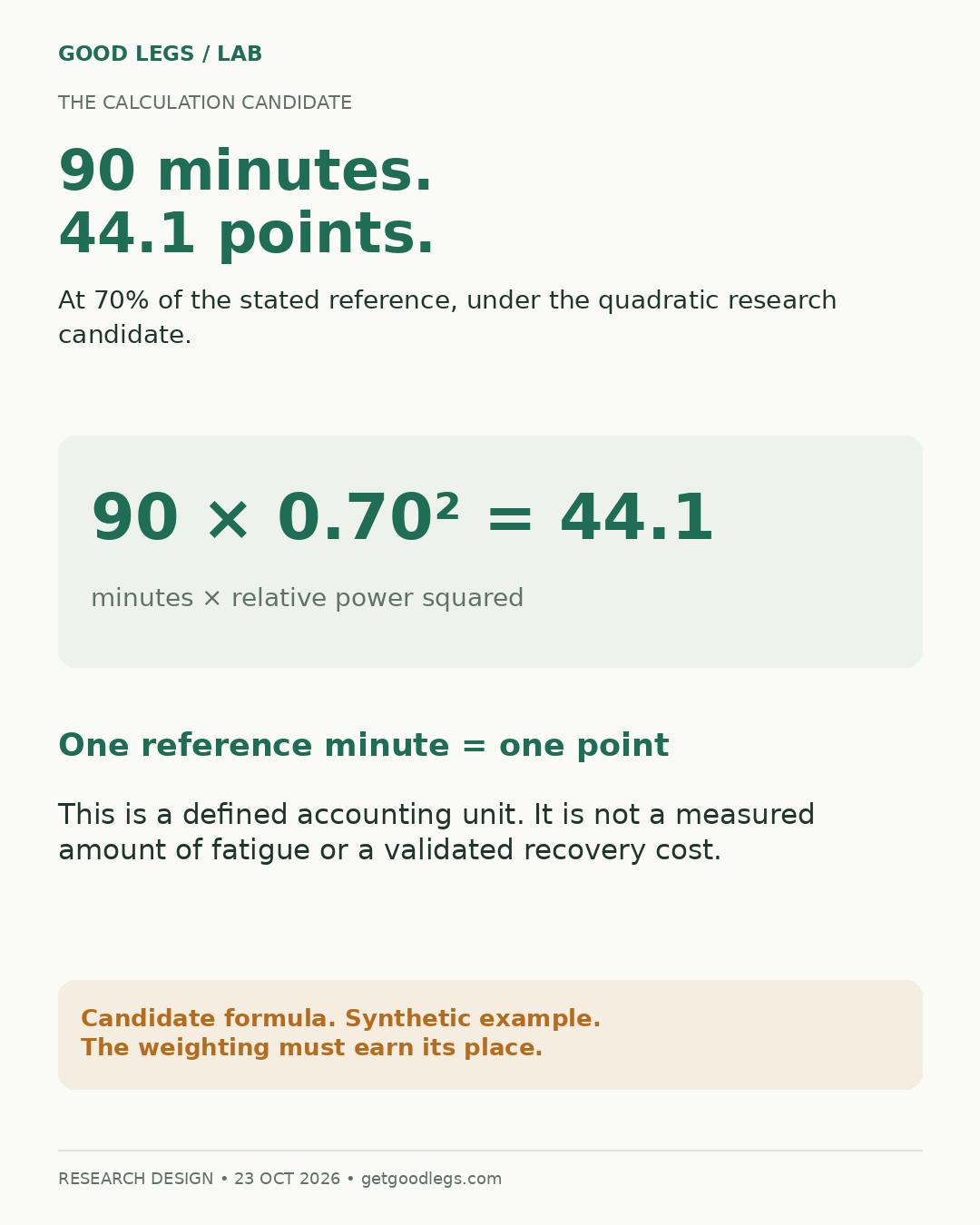
One candidate under investigation adds up time multiplied by relative power squared. In that candidate, 90 minutes at 70 per cent of the athlete's stated reference produces 44.1 points. One minute at the reference produces one point.
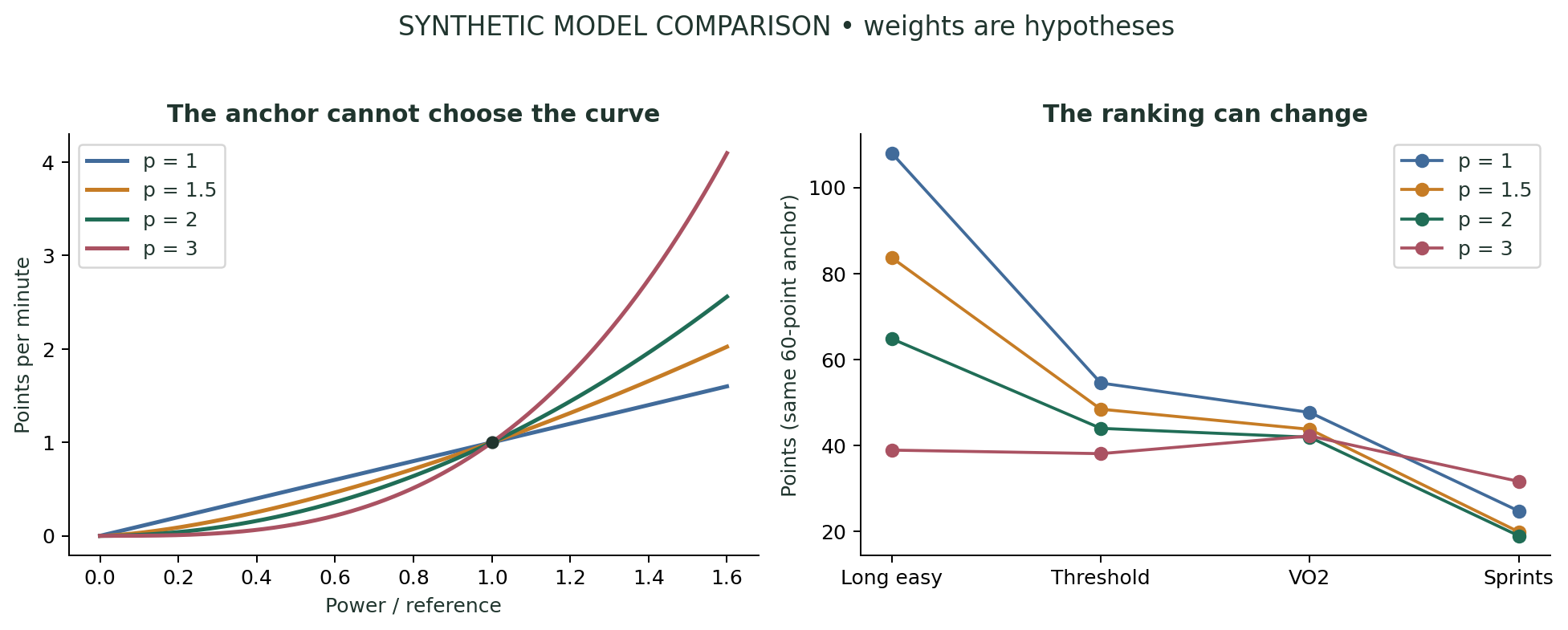
The arithmetic has a transparent definition, although calculating it correctly does not establish a law of fatigue or tell us how an athlete will respond. Other weighting curves are possible, and changing the curve can change which ride receives the higher score. The candidate needs to be compared with simpler measures and established alternatives before we make a claim that it is better.
The same discipline applies to the reference. Critical power and FTP are not automatically interchangeable, and a later improvement in the reference can lower the score of an unchanged ride. A useful system must preserve that distinction instead of treating every lower total as less training. [S54]
Three questions, connected
The Good Legs research programme separates three questions. What work did you complete? What kind of work was it? What happened to your ability to perform the tasks that matter to you?
The first supports a simple currency, while the second preserves the difference between endurance, sustained hard work, repeated efforts and sprints that a total can conceal. The third requires observations over time, including the context in which those observations were made.
That context can include strength training, heat, altitude, fuelling and the athlete's own report. It does not follow that every piece of context needs another score. We should collect additional information only when it helps enough to justify the effort.
The test is a better decision
Our intended research standard is demanding. A calculation must be reproducible. A forecast must work on later sessions and athletes it did not learn from. A prescription system must be tested against a credible alternative, with outcomes that matter beyond ticking off easy workouts.
If duration and a few simple descriptors work just as well, we should use them. If a richer model helps, we should show where, how much and for whom; when an idea fails, that result belongs in the evidence too.
The promise we are working towards is simple: count the work, explain its character and use the athlete's response to help plan what comes next. The score has to earn its role in that promise.
Research status: the proposed GL score is a candidate. The examples are synthetic; this article does not announce a validated metric or a production feature.
TEMPORARY ILLUSTRATION · SYNTHETIC DATA
Inspect the supplied illustration
This is a research placeholder while the final graphics are designed. Scroll inside the frame to read the original at full size, or open the image separately.
TEMPORARY ILLUSTRATION · SYNTHETIC DATA
Inspect the supplied illustration
This is a research placeholder while the final graphics are designed. Scroll inside the frame to read the original at full size, or open the image separately.
Sources and their limits.
- Karsten et al. (2021). The Relationship Between Critical Power and Functional Threshold Power in Cycling. Critical power and FTP are different estimates; this study does not validate a Good Legs calculation.