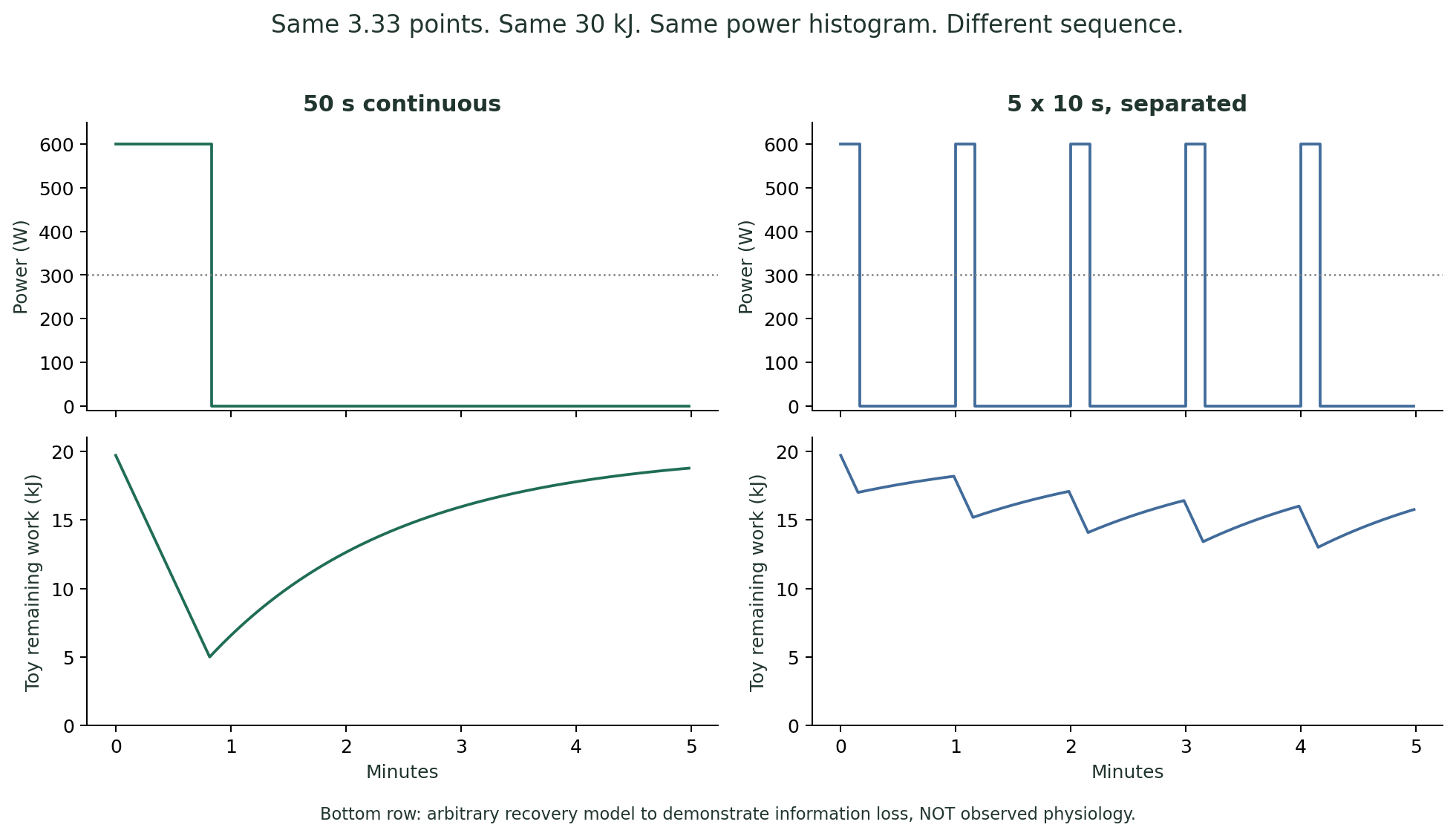
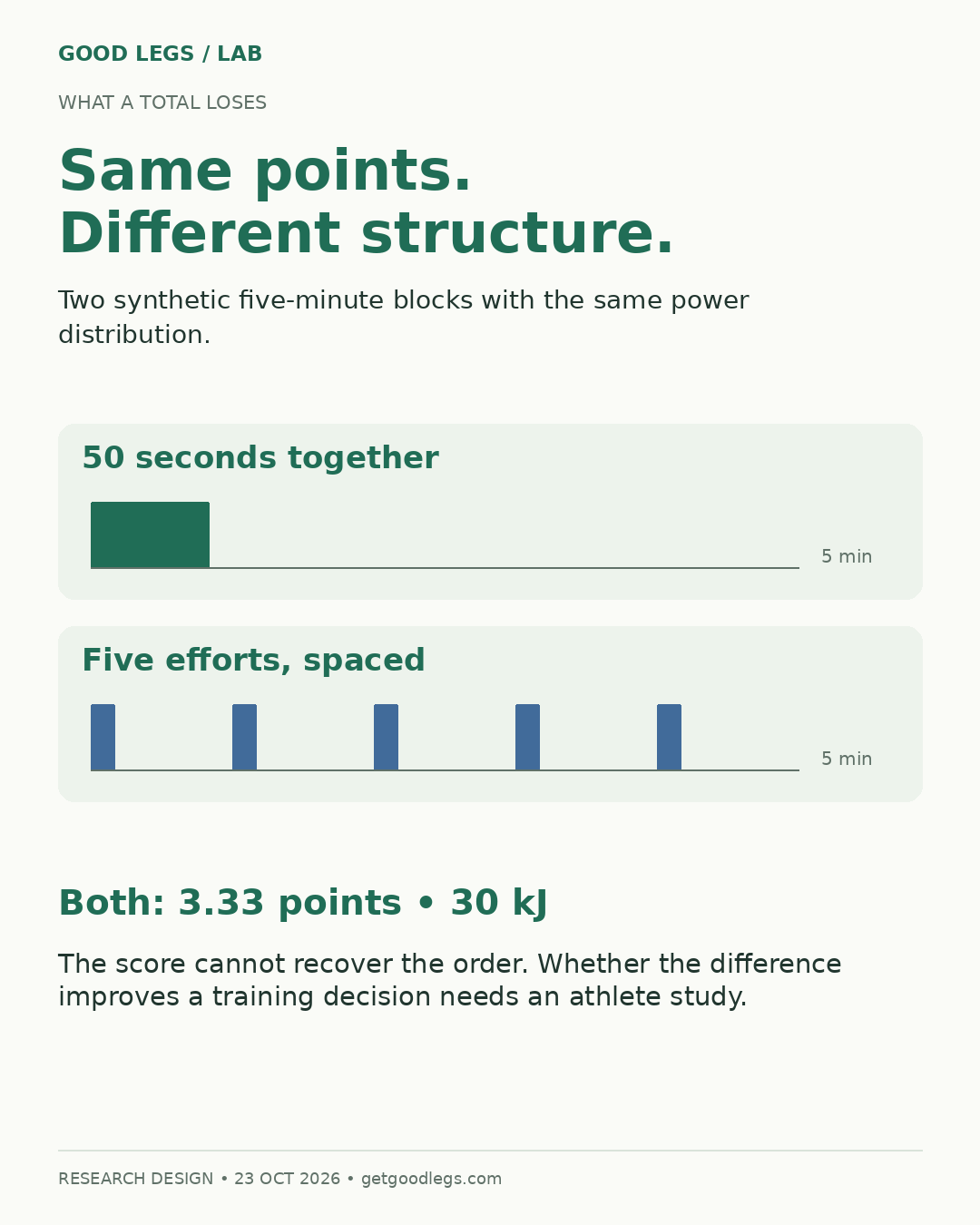
In the first, the rider produces 600 watts for 50 seconds and then coasts for the rest of 5 minutes. In the second, the rider completes five 10-second efforts at 600 watts, with 50 seconds of coasting between them.
Both contain exactly the same amount of time at each power and produce 30 kilojoules of mechanical work, despite arranging those hard seconds differently. With a 300-watt reference, both receive 3.33 points under the current quadratic GL research candidate.
The arithmetic follows its definition: the formula adds up weighted power over time, and those ingredients are identical even though the order of the efforts differs. What it does not retain is their order.
Why changing the curve is not enough
We can make high power count more heavily, choose a gentler curve or split the ride into more detailed bands, while still losing the sequence. None of those changes tells us whether the hard seconds came together or were separated by recovery.
This is a mathematical limitation of any score that simply adds a weight for each moment without keeping a memory of what came before. It is not a criticism unique to one brand or one exponent.
An order-sensitive model can produce different answers for the two patterns. In our synthetic demonstration, a simple hypothetical recovery model does exactly that. Those model outputs illustrate why the difference is worth testing, without measuring real athletes or establishing that we know the precise difference in their recovery. [D26]
The important experiment
The useful research question is whether this lost information changes a meaningful next decision. Does spacing predict the next prescribed task better than the headline score and power distribution? Does the answer depend on the athlete, the task or the time between sessions?
The earlier Foundation Review proposed controlled comparisons of sessions with matched scores or distributions. Those assigned-session designs are outside our current research scope. Observations of independently planned training can investigate associations between session structure and later outcomes, while retaining uncertainty and the limits of causal interpretation.
We must also account for the test itself. A maximal test immediately after a ride can affect performance the next day. It cannot be treated as if it added no training.
What this means for an app
The headline score remains useful for a calendar and a weekly total, alongside a session record that retains intervals, recovery lengths and the intended task. A coach or planning model can then use that information when it matters.
Equal points should mean equal values of a declared index. They should not promise equal fatigue, equal adaptation or the same gym recommendation tomorrow. A useful number becomes more trustworthy when its limits are easy to see.
Research status: all numerical sessions here are constructed examples. Their physiological effects have not been measured by Good Legs.
TEMPORARY ILLUSTRATION · SYNTHETIC DATA
Inspect the supplied illustration
This is a research placeholder while the final graphics are designed. Scroll inside the frame to read the original at full size, or open the image separately.
TEMPORARY ILLUSTRATION · SYNTHETIC DATA
Inspect the supplied illustration
This is a research placeholder while the final graphics are designed. Scroll inside the frame to read the original at full size, or open the image separately.
Sources and their limits.
- Good Legs (2026). Constructed arithmetic examples from the 23 October foundation review. The numerical rides and toy states are synthetic. They are not athlete observations or physiological validation. The original laboratory scripts are not published with these articles.