A cycling app can make a deceptively easy decision: whenever training looks demanding, reduce the gym session so tomorrow’s ride may be easier to complete.
But what if the athlete was also trying to become stronger? A system that repeatedly removes the training needed for that goal has not solved the whole problem.
The Good Legs research design treats strength as an explicit objective, with progress to protect alongside cycling rather than only fatigue to subtract from it.
A cycling score cannot count squats
Power and duration are useful cycling measurements, while a strength session needs the movement, working sets, repetitions, load, effort and whether the exercise is familiar.
The same tonnage can describe very different sessions, such as a familiar controlled movement and a new exercise with unusual demand while the muscle lengthens. A lower-body session does not ask the same question as upper-body or trunk work.
We are not proposing an exchange rate between cycling points and squats, because both histories can be considered while retaining the measurements that describe each one.
Adjust the session for a reason
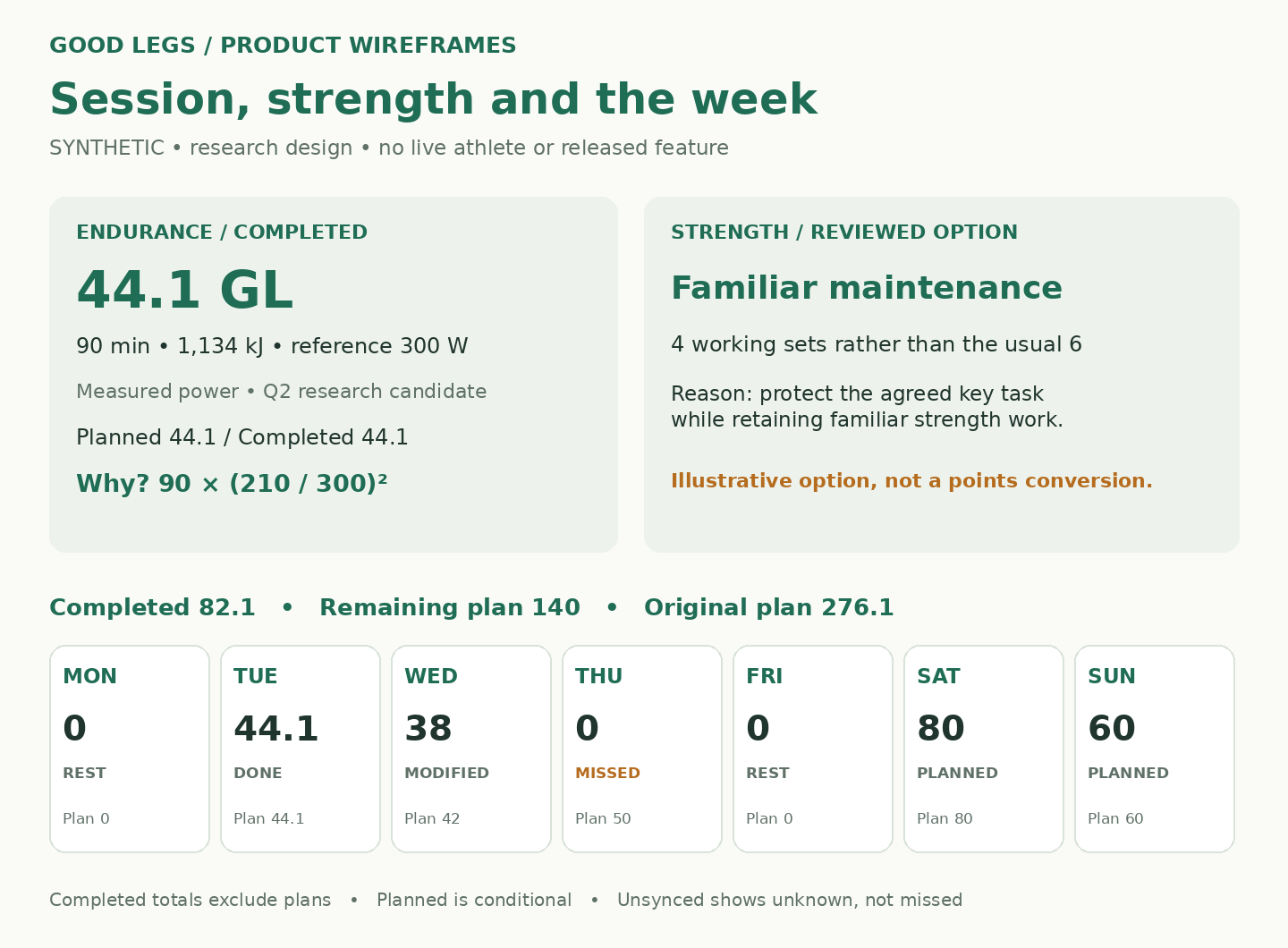
Useful options include keeping a familiar full session, using an approved maintenance variant, moving it or selecting an appropriate substitute. The choice should reflect the athlete's goals, upcoming key tasks and observed response.
A new block of hard cycling, unfamiliar lower-body work or arrival at altitude may justify holding further escalation while the athlete's response becomes clearer. A high weekly total alone does not tell us exactly how many sets to remove.
If six working sets become four, that is a one-third reduction in sets. It is not a measured one-third reduction in the body's stress. The explanation should say why that option was chosen, rather than attaching a fictional physiological precision to it.
Strength-training research in cyclists supports taking the objective seriously, while leaving uncertainty about the best day-to-day adaptive rule. The proposed GL algorithm still needs its own validation. [D06]
What a fair test looks like
First, the system should make recommendations in shadow mode while training remains under the agreed process. Researchers can inspect when it disagrees with a coach and whether the disagreement is useful.
Controlled scheduling trials were an earlier proposal, rather than part of the current proposed observational direction. Observing training choices does not establish the effect of changing them. Any future decision claim must protect the sporting objective and the strength objective, as well as adherence and athlete experience.
A rule that improves next-day ride completion by sacrificing meaningful long-term strength development should fail when strength is a protected goal. Equally, a rule that protects gym numbers while undermining the priority event has not succeeded.
The right question is not 'How do we make tomorrow easy?' It is 'How do we keep the athlete progressing towards the goals they chose?'
Research status: these are proposed design and study principles, not a released automatic strength and conditioning prescription system.
TEMPORARY ILLUSTRATION · SYNTHETIC DATA
Inspect the supplied illustration
This is a research placeholder while the final graphics are designed. Scroll inside the frame to read the original at full size, or open the image separately.
Sources and their limits.
- Llanos-Lagos et al. (online 2025; issue 2026). Heavy strength training effects on physiological determinants of endurance cyclist performance: a systematic review with meta-analysis. The review includes 17 studies and 262 participants, including 60 women. Certainty was low, and it does not establish an automatic daily strength-adjustment rule.