Closely matching an established score does not show whether a new metric helps an athlete make better training decisions.
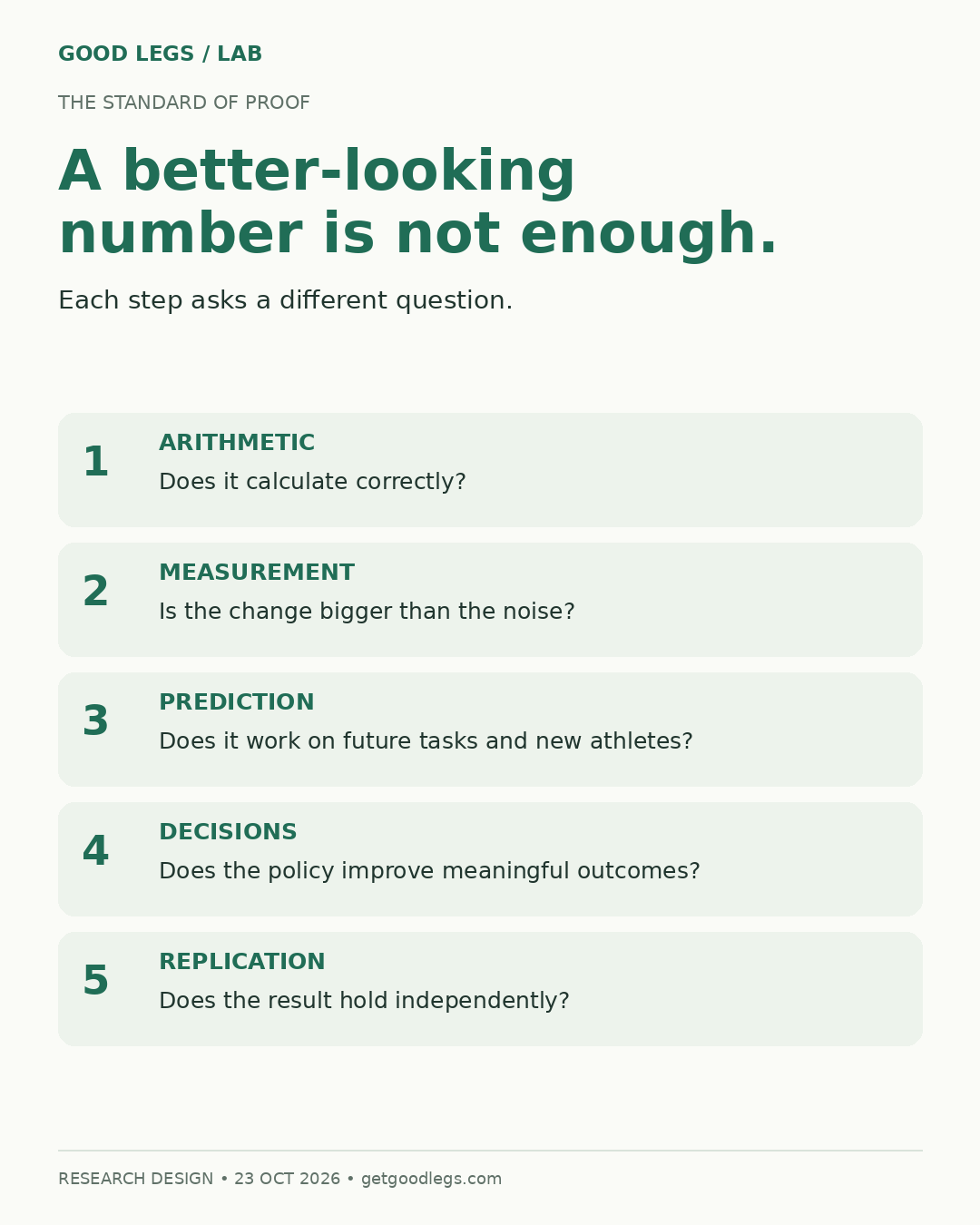
The Good Legs research programme proposes a sequence of tests that answer different questions, because a system can pass an early test and still fail the next one.
First comes arithmetic. Does the calculation match its published definition? Can a session be reproduced from its recorded data and reference? Does a missing power interval remain unknown rather than becoming a rest period?
Then comes measurement. If a device, recording method or reference estimate changes, does the apparent progression still mean what we think? A planned increase smaller than the measurement variation may not be distinguishable from noise.
Give the number a difficult exam
The next tests deliberately compare sessions that share a score but differ in intensity mix, or share an entire power distribution while differing in interval order.
These cases let us ask whether the score is enough for a particular outcome, or whether the retained structure adds something useful. The answer may differ between a short-power task, sustained work and performance after a long ride.
We should decide the main outcome and meaningful difference before seeing the results, so the study does not become a search for whichever comparison makes the model look good.
Tomorrow's data must stay in tomorrow
Forecasts need to be tested on later sessions and on athletes excluded from model development. A later threshold test must not quietly improve the reference used for an earlier prediction, because the model could not have known that result at the time.
The comparison should include simple alternatives: recent training time, mechanical work, previous performance and an established reviewed planning process. A complex system that cannot beat those deserves simplification.
A forecast is still not a prescription trial
Knowing that a task is likely to go poorly does not prove which alternative is best. The earlier controlled-study proposal is outside the current proposed observational direction. Forecast accuracy alone cannot establish that changing a session helps, and no autonomous prescription follows from it.
Success must include meaningful performance goals. A planner can improve completion rates by assigning easier work or protect cycling by repeatedly removing strength, without either result serving all the athlete’s agreed goals.
The proposed programme includes academic collaboration, independent statistical input, preregistration and publication of limitations and null results. No partnership has yet been agreed, and no athlete-outcome study in this programme has been completed.
That is the standard we want the number to meet: not simply a plausible explanation of the past, but evidence that its decisions help in the future.
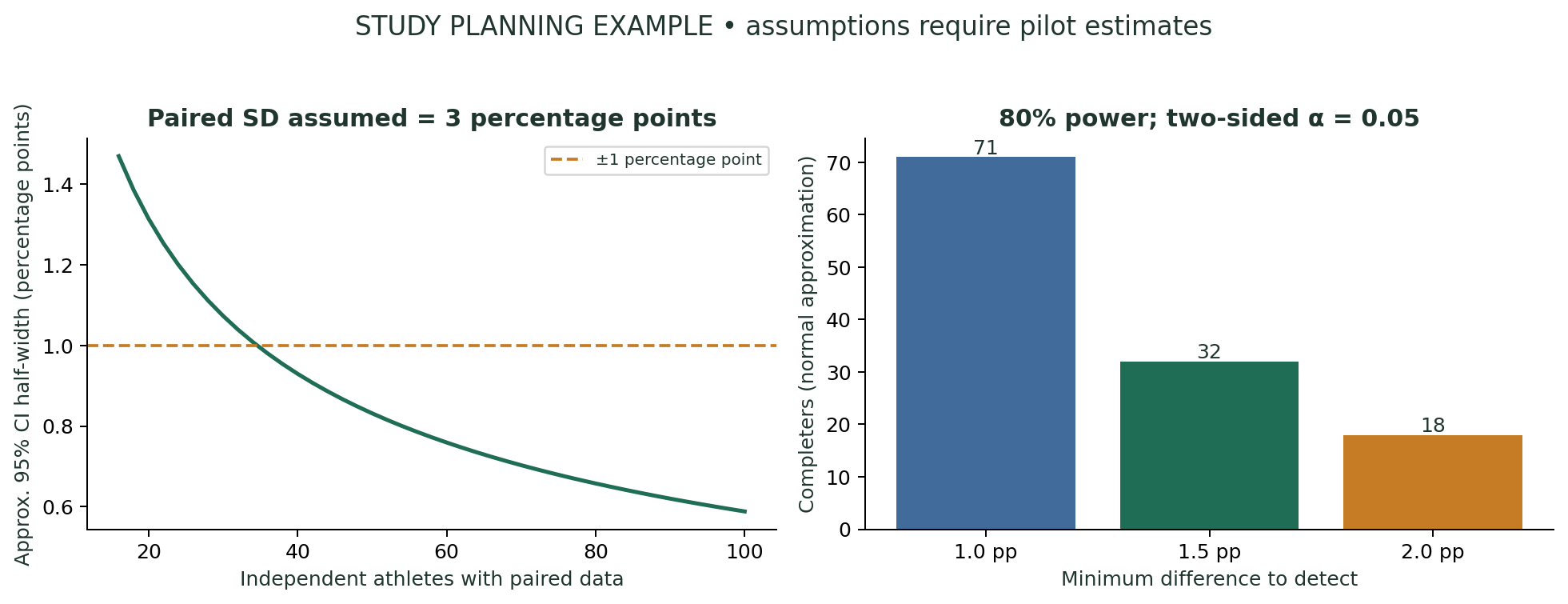
TEMPORARY ILLUSTRATION · SYNTHETIC DATA
Inspect the supplied illustration
This is a research placeholder while the final graphics are designed. Scroll inside the frame to read the original at full size, or open the image separately.
TEMPORARY ILLUSTRATION · SYNTHETIC DATA
Inspect the supplied illustration
This is a research placeholder while the final graphics are designed. Scroll inside the frame to read the original at full size, or open the image separately.