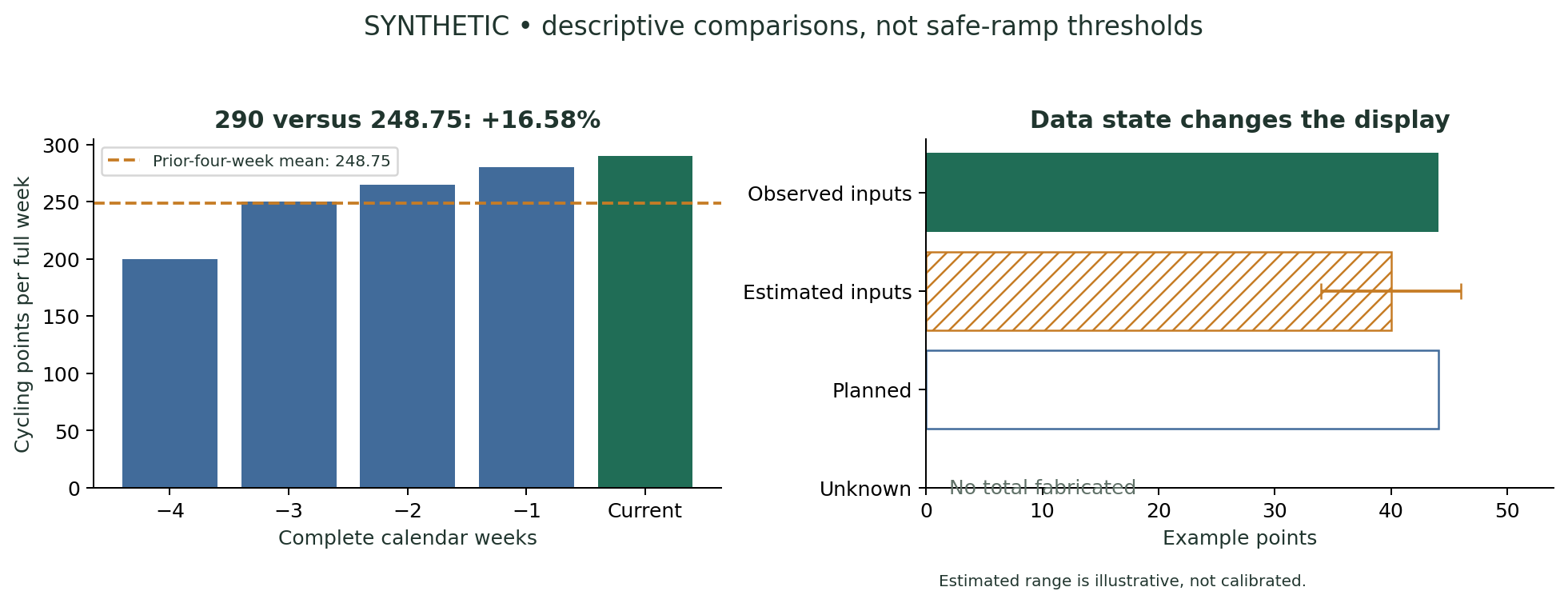
A training app should make that conversation easier by showing what was recorded. The difficulty comes when a simple comparison begins to sound like a ranking of who trained best.
Different riders have different goals, available time, experience and recent workloads, so a larger total does not automatically mean that their training was better. Their recorded data may also be very different.
A power meter gives more observable cycling detail than a record of time and effort alone, without establishing that the rider with less data trained less effectively.
Start with a clear question
A useful comparison might ask where an athlete's endurance duration sits among riders with similar available training time and a similar event phase. Another might compare above-reference exposure among athletes preparing for a relevant task.
The comparison group should fit that question: matching every characteristic can leave a tiny, biased group, while matching almost nothing can make the comparison meaningless.
The proposed GL framework therefore declares the metric, cohort, time window, data coverage and uncertainty. Each athlete contributes a defined observation to the comparison; thousands of sessions from a few highly active users should not pretend to represent thousands of people.
A percentile describes a sample
If your recorded endurance duration is around the 70th percentile, that describes its position in a specified group. It does not mean you are training better than 70 per cent of cyclists, or establish that adding more endurance would improve your own result.
The group is also a sample of consenting, observable users, not the whole cycling world. Geography, terrain and season can affect who appears in it and what their training looks like.
When the comparison is too uncertain or the group too small, the honest output is a limited description or no percentile. Privacy and the right to use the source data are part of whether the comparison should exist at all.
Your own history remains central
Peer context can help answer a social or planning question. Your own accepted workload, goals, completed tasks and response are usually more directly relevant to the next decision.
The intended Good Legs explanation is therefore specific: this is what you completed; this is how it compares with your recent history; and this is the limited context offered by a relevant group.
That is a useful conversation between riders. It avoids turning a training log into a contest for the highest number.
Research status: the peer framework is a proposal. No real cohort percentiles were calculated for this article.
TEMPORARY ILLUSTRATION · SYNTHETIC DATA
Inspect the supplied illustration
This is a research placeholder while the final graphics are designed. Scroll inside the frame to read the original at full size, or open the image separately.