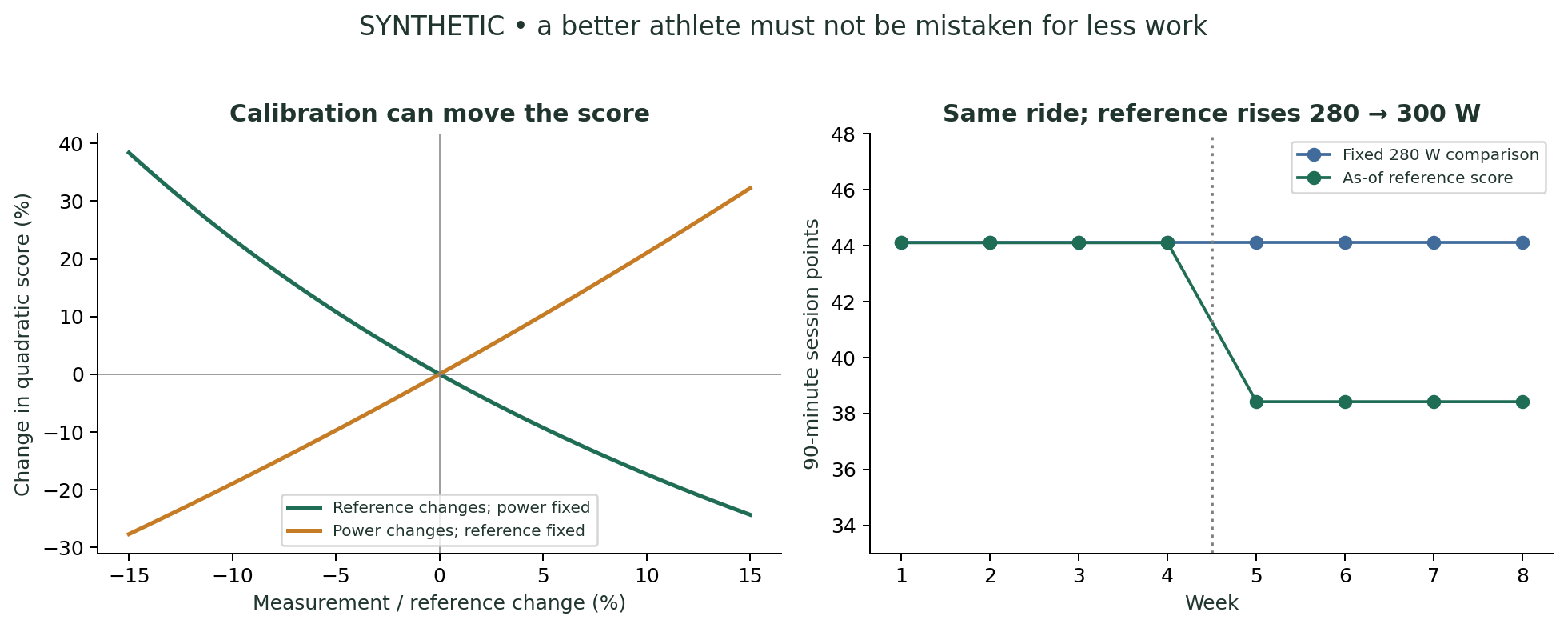
With a reference power of 280 watts, the ride is at 70 per cent of the reference used to calculate its relative score.
Under the quadratic GL research candidate, the calculation is 90 × 0.70²: 44.1 points.
Now suppose a reliable later assessment raises your reference to 300 watts. Repeat exactly the same ride at 196 watts. The calculation becomes 90 × (196/300)²: about 38.4 points.
You rode for the same time at the same power, so the mechanical work did not fall; the reference used in the calculation changed.
Two useful comparisons
The lower score describes the ride relative to a higher reference, while duration, mechanical work and the type of riding are still needed to explain what changed.
A historical comparison should also look at duration, work and the type of riding. It can use a common reference for both periods, clearly labelled, to isolate changes in what was completed.
The original recorded score should remain available too, because it documents the information used when the plan and session were evaluated rather than a later reinterpretation. A later test should not silently rewrite that decision history.
The trap for an automatic planner
If the planner sees fewer points and automatically adds riding to restore the old total, it may increase training because the athlete improved, not because there was a deliberate decision to increase work.
An increase might sometimes be appropriate, provided it is a deliberate progression decision supported by the goal, context and response, rather than an accidental consequence of the reference changing.
The same issue appears in device changes. If power measurement and the reference test share the same pure percentage calibration error, the ratio can cancel it; changing only one can move the score without changing the training.
What we intend to show
The proposed Good Legs detail view preserves the reference type, value, date and calculation version. Historical views distinguish as-recorded points from a declared common-reference comparison. Bruce can then explain why points changed before interpreting the change as progress or decline.
This is not extra complexity the athlete needs to manage every day. It is accounting the system should handle carefully so the simple answer remains trustworthy.
Research status: the numbers are synthetic and use the provisional quadratic formula. They demonstrate a mathematical property, not a measured improvement in an athlete. [D26]
TEMPORARY ILLUSTRATION · SYNTHETIC DATA
Inspect the supplied illustration
This is a research placeholder while the final graphics are designed. Scroll inside the frame to read the original at full size, or open the image separately.
Sources and their limits.
- Good Legs (2026). Constructed arithmetic examples from the 23 October foundation review. The numerical rides and toy states are synthetic. They are not athlete observations or physiological validation. The original laboratory scripts are not published with these articles.